



A Master’s Arrival
From a distance, I saw a bloodied horse galloping across the earth, its angry taunt piercing the air toward us—the enslaved souls bound to the tobacco plantation. And just like that, the master appeared, wielding the chains and shackles of time.
A wave of panic—one that only I could feel—overtook me. My heart shrank, my stomach churned, and my legs buckled against the hard ground. Hot urine seeped down my trembling thighs, my body betraying my fear.
Then my eyes locked onto my little sister’s broken body, devastatingly bruised, sprawled near the horse’s coronets. Her tattered dress clung feebly to her frail frame, and black blood mixed with sand oozed from her wounds. Her bandana, once a symbol of defiance, sagged on her left ear.
I remembered her solemn vow to me when she was in labor:
“I will discard this head-wrap only after my grave is dug.”
The Evolution of the Head-Wrap: From Tradition to Resistance
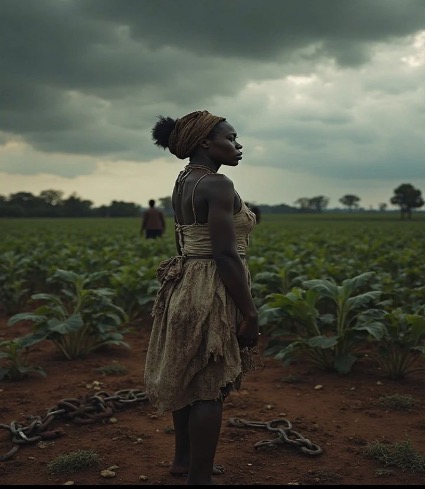
Even in chains, our ancestors carried the weight of dignity
The Symbolism of the Head-Wrap
To us, the head-wrap was our identity, our heritage, our pride. To the masters, it was nothing but a symbol of poverty and subjugation.
But the elders among us spoke a different truth. On the rare free days we were granted, we gathered beneath the evening sky to hear stories from those who still remembered the motherland.
The old men and women, their voices thick with wisdom and sorrow, told of African kings and queens who, out of greed or desperation, conspired with middlemen to sell their own kin.
“Long before the fifteenth century brought together Native Americans, Europeans, and Africans, slavery thrived across continents,” Grandpa Mason often said in his gruff tone. Though a free man, his anguish never ceased.
“My great-grandfather told me before he died: If I have anyone to blame for my indignity, it’s myself. We are the architects of our own suffering.”
But the wrinkled grandmothers told us a different tale, one that stirred pride rather than shame:
The Story of Our People
“My sons and daughters,” they would begin, “we are a people of strength and identity. Before the slave seekers desecrated our land, we thrived. In West Africa, your ancestry and mine, we were royalty. Our land overflowed with riches, our minds sharp with spirituality. We cured ailments with bare hands, lived harmoniously with nature, and loved fiercely.
Our head-wraps, once symbols of dignity, became the emblem of dishonor and servitude when the slavers came.”
The words rang through my mind as I turned to my sister once more. Her black face, glistening with pain, held no trace of regret. Instead, pride shimmered in her eyes, and a faint, knowing smile played on her lips, as if whispering to me:
“I will keep reading.”
The Master’s Wrath
I began to sing softly, the words of an old Negro spiritual spilling from my lips:
“Poor Rosy, poor gal;
Poor Rosy, poor gal;
Rosy, break my poor heart…”
But my tune was cut short.
The master’s voice thundered over us, his words like the crack of a whip.
“Now you will listen and obey!” he roared.
“Reading is not for you Negroes. You defy my orders with selfishness and stubbornness. If Rosy’s punishment doesn’t teach you, then picture what awaits you.”
With a swift slash, he cut the rope binding Rosy to the horse. A vicious whip cracked through the air, and the beast bolted toward the slave shack, vanishing into the master’s quarters.
We returned to the fields, our hands trembling, eyes heavy with sorrow, and our souls buried beneath the soil.
Rosy, battered but unbroken, staggered toward the shack—leaving behind a trail of strength, defiance, and sorrow.
Reader Reflection & Discussion Prompts
1. Symbolism & Identity – The head-wrap is portrayed as both a symbol of pride and a mark of oppression. How do cultural symbols today still carry dual meanings depending on perspective?
2. Historical Responsibility – Grandpa Mason believes that enslaved people share some blame for their suffering.
Do you agree or disagree? Why?
3. Resilience & Defiance – Despite her suffering, Rosy smiles and keeps reading. What does this say about the power of education and resistance in oppressive circumstances?
4. Personal Connection
Have you ever experienced or witnessed a situation where knowledge or self-expression was restricted? How did it affect you?